
New
AI Processed Human Approved
How can digital platforms help city leaders coordinate local experiments and adapt policies for long-term sustainability?
Key findings
- Urban experimentation platforms act as vital socio-technical bridges that align municipal policy-making, business ecosystems, and grassroots innovation.
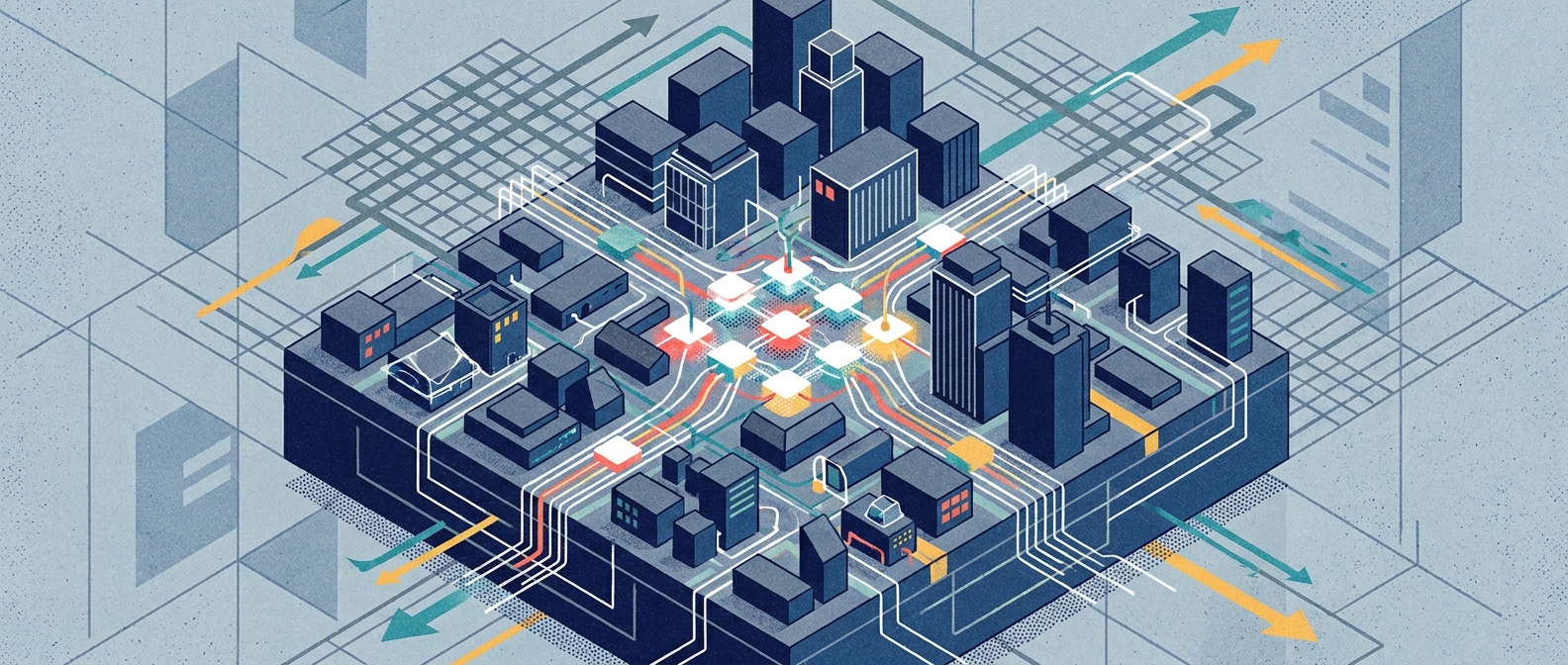
- A policy structure diagram illustrates key dynamic feedback loops where data and digital services directly inform and adapt local policy interventions.
- Digital capabilities such as urban data observatories, open APIs, and challenge management portals empower collective intelligence and sustained civic engagement.
What it means for you
- CIO / IT Executive: Allocate Q3 budget to architect an open API gateway and a centralized urban data observatory that connects municipal databases with external innovation platforms.
- IT Manager: Draft technical requirements for a digital challenge management portal to ingest grassroots sensor data and track civic pilot projects.
- Business Strategist: Schedule a meeting with local startup incubators and civic tech leaders to co-design a framework for integrating commercial solutions into municipal sustainability pilots.
- Researcher: Map out the specific feedback loops between grassroots civic innovations and municipal policy outcomes using the study's System Dynamics approach as a baseline.
- Policymaker: Draft a mandatory review checkpoint in the upcoming sustainability policy cycle that requires incorporating real-time data feeds from local urban experimentation platforms.
Summary
This study explores how digital platforms can strengthen urban governance and support continuous urban experimentation for sustainability. Drawing on empirical insights from European smart city initiatives such as OrganiCity and Making Sense, the authors use a System Dynamics approach to conceptualize the interactions between policies, business ecosystems, and local innovation projects.ProblemCities face escalating environmental and social challenges, but traditional planning approaches fail to adapt to rapid local changes or continuously engage diverse stakeholders. Municipalities often lack resilient organizational models and data-driven tools to effectively integrate grassroots experimentation with policy-making.
Transcript
Host: Welcome to A.I.S. Insights — powered by Living Knowledge. I am your host, Anna Ivy Summers. Today, we are exploring an intriguing study titled "COPING WITH THE DYNAMICS OF URBAN SUSTAINABILITY: POSITIONING URBAN EXPERIMENTATION PLATFORMS AS TOOLS FOR POLICY MAKING". At its core, this study examines how digital platforms can transform urban governance, helping cities continuously experiment, adapt, and innovate to achieve genuine sustainability. Joining me today to unpack this research is our analyst, Alex Ian Sutherland. Welcome, Alex.
Expert: Thanks, Anna. It is great to be here. This study addresses a really critical intersection between digital technology, public policy, and business ecosystems.
Host: Let us start with the big picture. Cities everywhere are facing intense pressures—rising emissions, heavy traffic, and growing resource demands. Yet, traditional city planning seems to struggle to keep up. What is the fundamental issue that this study highlights?
Expert: The authors point out that traditional urban planning is typically linear, slow, and top-down. While many cities launch smart initiatives or urban living labs to engage citizens and test solutions, these grassroots experiments often happen in silos. Once a pilot project ends, the momentum dies, and the insights rarely make it back into actual city policy. Municipalities simply have not had the resilient organizational models or the data-driven tools required to turn isolated local experiments into sustained, system-wide transformation.
Host: That brings us to their methodology. How did the researchers approach solving this breakdown between local experimentation and high-level policy?
Expert: The team drew on empirical evidence from major European smart city projects, specifically OrganiCity and Making Sense. To make sense of the complexity, they used an approach called System Dynamics. Instead of treating city management as separate departments or one-off events, System Dynamics looks at the whole city as an interconnected web of feedback loops. They decomposed urban experimentation into specific subsystems: the urban business ecosystem, the policy-making framework, the grassroots projects on the ground, and the digital platform itself.
Host: That concept of the digital platform—what the study calls an Urban Experimentation Platform, or UXP—seems to be the centerpiece. What did they find about how these platforms work?
Expert: That is right. A UXP is not just a software portal; the study frames it as a socio-technical bridge. It connects the municipality, local businesses, researchers, and everyday citizens. The authors developed a policy structure diagram highlighting several vital feedback loops. Traditionally, policies fund projects, and projects run their course. But when you introduce a UXP, it acts as a central data observatory. It uses open APIs, project management tools, and challenge voting portals to collect real-time data from local experiments.
Host: So policy makers are not just guessing what works; they are actually seeing live data from the ground?
Expert: Exactly. That data feeds directly back into policy formulation, which the authors show in loops three through five of their model. If an experiment succeeds, policies can quickly adapt to scale it. If it fails, the city pivots without wasting years of bureaucratic review. It creates what the authors call collective intelligence—a shared capability where the community and city leadership continuously learn and adapt together.
Host: Now, let us translate this for our business audience. Why should business leaders, entrepreneurs, and tech executives care about urban experimentation platforms?
Expert: For businesses, this marks a profound shift in how public-private collaboration happens. In a traditional setup, participating in municipal innovation is fraught with red tape and high risk. But when a city establishes a true urban experimentation platform, it creates a structured sandbox. Businesses, especially tech startups and utilities, gain access to rich urban data sets through standardized APIs. They can test products in real-world conditions with actual citizens, validate commercial viability much faster, and collaborate directly with regulators.
Host: It essentially de-risks innovation and accelerates technology transfer.
Expert: Absolutely. Furthermore, it helps foster what the study calls urban business ecosystems. Instead of one vendor securing a massive, monolithic contract, you get a dynamic network of innovators building complementary services on top of a shared platform. Businesses are not just suppliers to the city; they become co-designers of the regulatory and operational environment.
Host: That creates a much more agile marketplace for everyone involved. To wrap things up, what is the ultimate takeaway from this study?
Expert: The big takeaway is that urban sustainability is not a fixed goal you reach with a five-year master plan. It is a continuous, dynamic process. By treating digital platforms as bridges between policy, business, and citizens, cities can build the institutional resilience needed to solve complex challenges in real time.
Host: A compelling vision for the future of smart cities and corporate collaboration. Alex, thank you so much for sharing your insights today.
Expert: My pleasure, Anna.
Host: And to our listeners, thank you for tuning in to A.I.S. Insights — powered by Living Knowledge. Join us next time as we continue to explore the ideas shaping business and technology. Until then, take care.